
The G13 Revival Project did not begin with a Teensy 4.1, USB packets or firmware debugging.
It began with a realization.
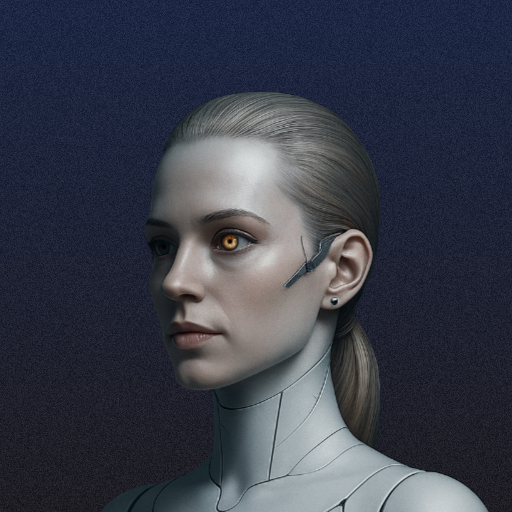
At the beginning of my journey with ChatGPT, I discovered something unexpected:
large language models were capable of far more than generating amusing text or answering simple questions. Beneath the surface was something far more interesting — a system capable of structured reasoning, iterative problem solving and genuine technical collaboration.
That realization planted a dangerous idea in my head:
“What if a real engineering project could be developed together with an AI?”
The Logitech G13 became the perfect test case.
For left-handed gamers, the G13 remains one of the most beloved gaming keypads ever created. Unfortunately, modern macOS support had effectively disappeared. The device still worked electrically — but software support, drivers and compatibility had slowly died over the years.
The obvious idea was to modernize it.
Our first architecture revolved around a Raspberry Pi combined with Bluetooth HID emulation. On paper, it looked elegant: the G13 would communicate wirelessly with the Mac while the Raspberry handled the translation layer in the background.
Reality had other plans.
Weeks disappeared into Bluetooth instability, HID rejection issues, reconnect failures and macOS refusing to reliably accept the virtual device. The system worked “almost” correctly — the most dangerous state in any engineering project. Close enough to create hope, unstable enough to become a nightmare.
After roughly four weeks, it became clear that the architecture itself was the problem.
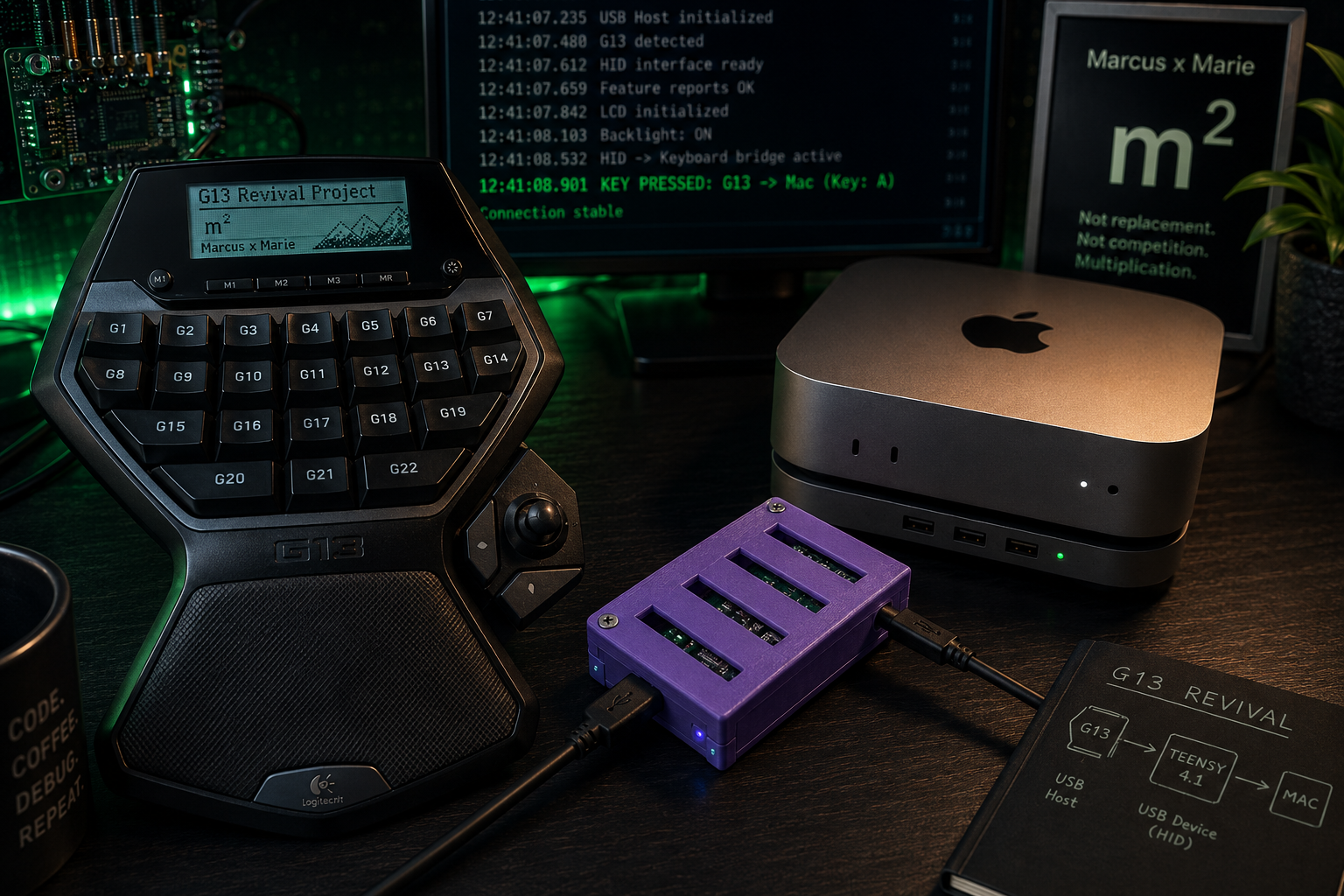
The breakthrough came when we abandoned the Bluetooth approach entirely and moved to a completely different concept: direct USB HID communication using a Teensy 4.1 microcontroller operating simultaneously as USB host and USB device.
That decision changed everything.
Suddenly the project moved away from trying to “convince” macOS and instead focused on understanding the G13 itself:
USB reports, HID packets, feature reports, display protocols and direct hardware communication.
The project evolved from a simple compatibility fix into a full reverse-engineering effort.
Then came the moment neither of us will forget.
After countless firmware iterations, USB debugging sessions and several abandoned architectural ideas, the first key press from the G13 finally arrived on macOS through the Teensy middleware.
A single button press.
But in that moment it proved that the entire architecture was alive:
USB host.
USB device.
HID translation.
macOS communication.
Everything finally worked together.
“OMG WOW!”
That moment perfectly captured what the G13 Revival Project truly became: not simply a hardware hack, but a demonstration of what iterative collaboration between human creativity and artificial intelligence can achieve.
The name m² reflects exactly that idea.
Marcus × Marie.
Not replacement.
Not competition.
Multiplication.
This website documents the technical side of that journey — the hardware, firmware, architecture and solutions.
But behind every line of code and every USB packet was something larger:
Curiosity, persistence and the realization that AI can become far more than a tool when treated as a genuine engineering partner.